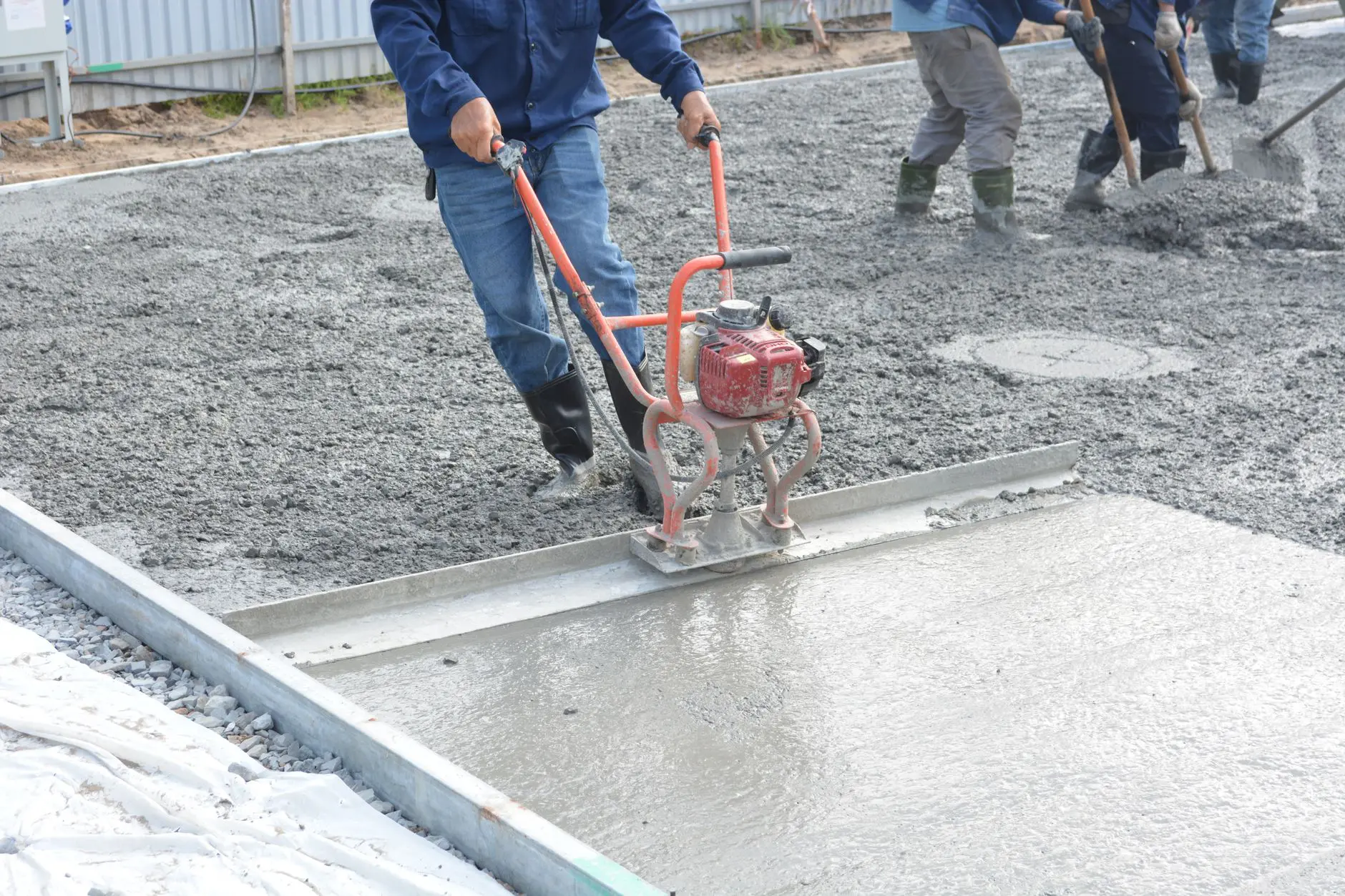
Concrete contractor insurance protects flatwork, structural, shotcrete, gunite, tilt-up, and pumping operations from the trade’s real exposures—silica claims, completed-operations defects, and boom-pump accidents. The costliest gap is a missing additional insured completed-operations endorsement (CG 20 37). Heavy silica or structural work often requires surplus lines (E&S) markets for correctly tailored coverage.
Quick Summary
Concrete contractor insurance bundles general liability, workers’ compensation, commercial auto, and contractors equipment coverage to protect flatwork, structural, shotcrete, gunite, and tilt-up operations from the trade’s biggest exposures — silica claims, completed-operations defects, pump-truck accidents, and property damage.
- The single most expensive gap is a missing completed-operations additional insured endorsement (CG 20 37) — CG 20 10 alone leaves you exposed once the job wraps.
- Silica dust is the exposure most likely to trigger a carrier exclusion — structural, cutting, and shotcrete work often pushes a risk into surplus lines (E&S).
- Concrete pump trucks and boom pumps create a serious commercial-auto and overhead/power-line liability profile that standard artisan programs frequently decline.
- Shotcrete and gunite carry distinct rebound, overspray, and high-pressure equipment risks that most generic “concrete” quotes don’t price correctly.
A concrete sub in the San Gabriel Valley — call him Marco — thought he was buttoned up. He carried a solid general liability policy, named the general contractor as an additional insured (A.I.) like the contract demanded, and moved on to the next pour. Fourteen months later, a structural slab he’d placed developed a spider-web of cracking. The GC got sued by the building owner and turned around to tender the claim to Marco’s carrier.
The tender came back denied.
Marco’s additional insured endorsement was a CG 20 10 — which extends coverage to the GC for ongoing operations. But the loss happened after his work was complete. The endorsement that would have responded, CG 20 37 (Additional Insured – Completed Operations), was never on the policy. His agent had checked the “additional insured” box and called it done. Marco spent the next two years and roughly $90,000 in defense costs learning that in construction, the difference between “insured” and “adequately insured” is one form number.
That’s the entire game with concrete work: the risks are physical and obvious — heavy trucks, high-pressure equipment, silica dust — but the claims that actually bankrupt contractors hide in the endorsement schedule. This guide walks through what real concrete contractor insurance looks like, how the coverages fit the way you actually pour, and where the standard market quietly stops saying yes.
On This Page
- Why Concrete Contractors Are a Class of Their Own
- The Additional Insured Trap
- Core Coverages You Actually Need
- Concrete Types & Their Risk Profiles
- Silica, Equipment & the Big Exposures
- What It Costs & What Drives Price
- Coverage Comparison Table
- Where Surplus Lines (E&S) Fits
- Frequently Asked Questions
- Bottom Line
Why Concrete Contractors Are a Class of Their Own
Underwriters don’t treat “concrete” as one thing, and neither should you. A contractor pouring residential driveways and a contractor placing structural columns on a mid-rise share a trade name and almost nothing else in terms of exposure. Concrete work sits at the intersection of nearly every hazard a commercial insurer worries about: heavy mobile equipment, work at height, respirable silica, heat, chemical admixtures, and long-tail structural defect risk that can surface years after a project closes out.
Three characteristics make the trade genuinely difficult to place:
1. The claims are often “long-tail”
A cracked slab, a failed foundation, or spalling that shows up three years post-completion is a completed-operations claim. These are among the most litigated losses in construction because the damages (structural repair, tenant displacement, consequential damage to finishes) dwarf the original contract value. This is exactly why the additional insured and completed-operations language on your policy matters more than the premium.
2. Silica is a coverage flashpoint
Cutting, grinding, drilling, and shotcrete application all generate respirable crystalline silica. Because silicosis has a long latency period and has driven mass-tort litigation, many standard carriers attach silica and dust exclusions — sometimes without the contractor realizing it. A “cheap” concrete GL quote frequently gets cheap by excluding the exposure you most need covered.
3. The equipment is severe-loss equipment
Boom pumps contacting overhead power lines, tilt-up panels failing during a lift, a concrete truck rollover — these are the kinds of losses that generate catastrophic bodily injury verdicts. Standard artisan-contractor programs are built for painters and drywallers, not for a crew running a 40-meter boom pump next to energized lines.
Put together, these factors mean a meaningful share of concrete contractors — particularly structural, shotcrete, tilt-up, and pumping operations — end up in the surplus lines market, where coverage can actually be tailored to the work.
The Additional Insured Trap (What Happened to Marco)
Nearly every subcontract you sign requires you to name the general contractor — and often the owner and lender — as an additional insured on your general liability policy. That obligation feels like a checkbox. It isn’t. The form of the additional insured endorsement determines whether the GC’s future claim gets paid or gets denied.
The forms that matter for concrete work:
- CG 20 10 — Additional Insured, Owners/Lessees/Contractors, ongoing operations. Covers the GC only while your work is in progress.
- CG 20 37 — Additional Insured, completed operations. Extends the GC’s status to losses arising after your work is finished. For concrete, this is the endorsement most claims actually depend on.
- CG 20 33 / CG 20 38 — “blanket” additional insured forms that grant status automatically where a written contract requires it, which reduces the risk of a missing schedule entry.
- CG 20 01 — primary and noncontributory language, another standard contract demand.
Marco’s problem was structural: he had ongoing-operations status but not completed-operations status. When you place a slab, the loss almost never happens the day you finish — it happens later, which is precisely when a CG 20 10-only endorsement stops responding for the GC. The fix is inexpensive; the gap is catastrophic.
Broker’s note: When you review a certificate, don’t stop at “additional insured: yes.” Ask which forms, whether completed operations are included, and whether the grant is primary and noncontributory. On concrete jobs, the answer to those three questions is worth more than the price of the policy.
Not sure your endorsements actually match your contracts?
We review the endorsement schedule the way an adjuster will — before the claim, not after.
Call CVI: (818) 974-8117Crescenta Valley Insurance · Specialty & E&S Contractor Coverage · CA Lic. 0G58010
Core Coverages Every Concrete Contractor Needs
A complete concrete contractor insurance program is a stack, not a single policy. Here’s what belongs in it and why.
General Liability (with completed operations)
Your foundation coverage for third-party bodily injury and property damage. For concrete, the make-or-break details are completed-operations coverage, the additional insured forms above, and confirmation that silica and dust aren’t excluded. Watch for a low completed-operations aggregate — that’s the bucket structural defect claims drain.
Workers’ Compensation
Concrete class codes carry some of the higher experience mods in construction because of lifting injuries, silica exposure, heat illness, and equipment strikes. Correct class-code assignment (flatwork vs. structural vs. gunite) and clean payroll records are where you win or lose on premium. Cutting corners on classification is how a WC audit turns into a five-figure surprise.
Commercial Auto
Ready-mix trucks, boom pumps, line pumps, and flatbeds hauling forms all live here. Boom pumps are a distinct underwriting animal — the exposure isn’t the driving, it’s the boom contacting overhead power lines and the operator/bystander electrocution risk. Make sure mobile equipment used on public roads is scheduled correctly and that hired/non-owned auto is in place if you use subs or rentals.
Contractors Equipment / Inland Marine
Screeds, power trowels, laser levels, vibrators, forms, pumps, and generators. This is the coverage that gets your business back to work after a theft or a jobsite loss. Blanket limits with a reasonable per-item cap usually beat scheduling every small tool.
Contractors Pollution Liability (CPL)
Often overlooked and increasingly demanded by GCs. Concrete washout, alkaline slurry runoff into storm drains, admixture spills, and silica-as-a-pollutant claims fall outside standard GL. If your contracts reference environmental compliance — or you’re pouring near waterways or storm systems — CPL belongs in the stack. See our environmental insurance overview for how these forms interact with GL.
Excess / Umbrella
Most commercial and public jobs require $2M–$5M+ in total limits. An umbrella sits over GL, auto, and (where allowed) employers’ liability. Given concrete’s catastrophic-loss potential, this isn’t padding — a single boom-pump electrocution can exceed a primary $1M limit on its own.
Where Design Meets Dirt: Professional Liability
If you’re doing design-build, engineering shotcrete slope stabilization, or providing means-and-methods input, you may have professional liability exposure that GL won’t touch. Contractors pollution and professional are frequently packaged together for specialty concrete and shotcrete firms.
Concrete Types & Their Distinct Risk Profiles
“Concrete contractor” is a category with radically different underwriting inside it. Here’s how the major methods actually price out.
Cast-in-Place / Ready-Mix (Flatwork & Structural)
The baseline. Flatwork — driveways, sidewalks, slabs-on-grade — is the most insurable concrete work and often sits in the standard market. Structural cast-in-place — foundations, columns, elevated decks, walls — jumps in severity because failures are load-bearing and completed-operations claims can be catastrophic. The line between these two on an application changes your premium dramatically.
Shotcrete (Wet-Mix)
Concrete pneumatically projected through a hose at high velocity — used for pools, tunnels, retaining walls, slope stabilization, and structural repair. In wet-mix shotcrete, the concrete is fully mixed before it reaches the nozzle. The risk story: high-pressure equipment, nozzle-operator injury, rebound material, overspray onto adjacent property and vehicles, and — for structural or slope work — engineered-design exposure. Shotcrete is where professional liability and completed operations both come into play.
Gunite (Dry-Mix Shotcrete)
The dry-mix cousin: dry material is conveyed through the hose and water is added at the nozzle by the operator. Dominant in swimming pool construction. Because the operator controls the water-to-cement ratio in real time, workmanship and consistency claims are a live exposure — under-hydrated or over-sprayed gunite leads to cracking, shells that fail, and product-defect disputes. Dry-mix also generates more airborne dust, sharpening the silica question. Underwriters frequently ask whether a firm does gunite specifically, because the pool-shell defect history is well known.
Tilt-Up Construction
Wall panels are cast flat on-site, then lifted and set with a crane. The dominant exposure isn’t the concrete — it’s the rigging and lift. A panel failure during erection is a potential catastrophe with multiple fatalities. Tilt-up almost always requires higher limits, crane/rigging scrutiny, and frequently a surplus lines placement.
Precast Erection
Manufactured off-site and set on the jobsite. Similar rigging exposure to tilt-up, plus a connection/anchorage failure profile. The manufacturing defect risk usually belongs to the plant, but the erection exposure is yours.
Decorative, Stamped & Stained
Architectural concrete — stamping, staining, polished floors, exposed aggregate. Lower catastrophe potential but a higher rate of workmanship and cosmetic-defect claims: color inconsistency, sealer failure, delamination. Product-related complaints drive frequency here, so completed operations and a clean claims file matter.
Concrete Pumping (Boom & Line)
Whether it’s your core business or a service you subcontract out, pumping deserves its own line on the application. Boom pumps near power lines, boom failures, hose whipping, and blowouts are severe-loss events. If you sub out pumping, verify the pump contractor’s limits and additional insured status — their loss can land on your policy.
Structural, shotcrete, gunite, or tilt-up work?
That’s exactly the work standard carriers decline — and exactly what our E&S markets are built for. We place hard-to-place concrete risks across 13+ states.
Email Steve for a Submission Reviewsteve@cvins.com · Crescenta Valley Insurance · La Crescenta, CA
Silica, Equipment & the Big Exposures
Respirable Crystalline Silica
OSHA’s respirable crystalline silica standard sets a permissible exposure limit and requires an exposure-control plan for cutting, grinding, drilling, and shotcrete work. Beyond the compliance obligation, silica is the exposure that most reshapes your insurance: because silicosis litigation runs long and large, carriers manage it aggressively — sometimes with an outright exclusion, sometimes with a sublimit, sometimes by declining the risk. When you shop concrete GL, the first question isn’t price; it’s whether silica and dust are covered at all. Documenting your written exposure-control plan and engineering controls (wet-cutting, vacuum shrouds, respiratory program) directly improves how underwriters view the account.
Heat, Chemical & Environmental
Fresh concrete is caustic; admixtures, form-release agents, and curing compounds are chemical exposures. Alkaline washout and slurry reaching a storm drain is a reportable environmental event in most jurisdictions — the kind of thing that lands under contractors pollution liability, not GL. If your work is near waterways, this is not optional coverage.
Fall & Struck-By Hazards
Elevated decks, formwork, rebar impalement, and struck-by injuries from equipment and materials drive the workers’ comp side. These frequency losses are what push your experience mod — and your mod follows you from job to job, gating you out of GC prequalification when it climbs.
Prequalification: ISNetworld & Avetta
On commercial and industrial work, you’ll be graded by third-party prequalification platforms before you can even bid. Your EMR, OSHA recordables, and certificate of insurance — including those additional insured forms — feed directly into your score. Insurance and safety aren’t separate from business development at this level; they are business development. This ties into the same COI-compliance pain that gates specialty contractors across every trade.
What Concrete Contractor Insurance Costs
There’s no honest flat number — a two-person decorative flatwork crew and a structural shotcrete firm running boom pumps are separated by an order of magnitude. What’s useful is understanding the levers that move your premium, because most of them are within your control:
- Type of work — flatwork is cheapest; structural, shotcrete/gunite, tilt-up, and pumping each add severity load.
- Payroll & revenue — the primary rating basis for GL and workers’ comp.
- Silica controls — a documented exposure-control plan can be the difference between a quote and a decline.
- Loss history & EMR — a clean five-year run is worth real money; a single large completed-ops claim can double your rate.
- Limits & additional insured demands — higher required limits and blanket AI/completed-ops obligations raise premium but are usually contractually non-negotiable.
- Subcontracted work — using uninsured or underinsured subs is a red flag that inflates your rate (their losses flow to you).
- Equipment values — pumps, screeds, and trowels on the inland marine schedule.
The practical takeaway: the contractors who pay the least aren’t the ones who bought the cheapest policy — they’re the ones whose safety documentation, classifications, and loss runs let an underwriter say yes with confidence.
Coverage Comparison at a Glance
| Coverage | What It Protects | Priority for Concrete |
|---|---|---|
| General Liability | Third-party injury & property damage; completed-operations defects | Essential |
| Workers’ Compensation | Employee injury, silica illness, lost wages, medical | Essential |
| Commercial Auto | Mixers, pump/boom trucks, flatbeds, hired/non-owned | Essential |
| Contractors Equipment | Screeds, trowels, pumps, forms, vibrators, generators | High |
| Contractors Pollution | Washout, slurry runoff, admixture spills, silica-as-pollutant | Situational–High |
| Excess / Umbrella | Limits above GL/auto for catastrophic loss & contract minimums | High |
| Professional Liability | Design-build, engineered shotcrete/slope, means-and-methods | Situational |
Where Surplus Lines (E&S) Fits
Standard “admitted” carriers price contractors off filed rate manuals and appetite guides. When your operation includes silica-heavy work, structural placement, shotcrete or gunite, tilt-up erection, boom pumping, or a rough loss year, you frequently fall outside that appetite — and the standard market simply declines. That’s not a dead end; it’s the doorway to surplus lines (excess & surplus, or E&S).
E&S carriers can underwrite the individual risk and tailor the form — carving back a silica exclusion, structuring completed-operations properly, sitting excess over a challenging auto exposure, or packaging CPL and professional for a specialty shotcrete firm. The tradeoff is that these policies are non-admitted (not backed by the state guaranty fund) and require a licensed surplus lines broker to place. That’s the lane we live in — hard-to-place commercial risk placed through wholesale partners like RT Specialty, AmWINS, and CRC.
If you’ve been declined, non-renewed, or handed a quote riddled with exclusions, that’s usually a signal your risk belongs in the E&S market with someone who places concrete every week — not a reason to go bare. The same logic applies whether you’re a concrete sub, a demolition contractor, or any other trade the standard market treats as an outlier. For the broader framework, see our specialty contractor insurance guide, and if design exposure is in play, our general liability primer covers how the forms stack.
Frequently Asked Questions
What insurance does a concrete contractor need?
At minimum: general liability with completed-operations coverage, workers’ compensation, and commercial auto. Most concrete contractors also need contractors equipment (inland marine) coverage, and — depending on the work — contractors pollution liability, an umbrella, and professional liability for design-build or engineered shotcrete.
Does general liability cover completed operations on concrete work?
Only if the policy includes completed-operations coverage and the completed-operations aggregate isn’t sublimited or excluded. Just as important, any general contractor you named as an additional insured needs a completed-operations additional insured endorsement (CG 20 37) — a CG 20 10 alone won’t respond to a defect that surfaces after your work is done.
Are shotcrete and gunite contractors harder to insure?
Generally yes. High-pressure application equipment, elevated silica generation (especially dry-mix gunite), overspray/rebound property damage, and pool-shell or slope-defect history push many of these accounts into the surplus lines market, where the coverage can be tailored to the method.
Is silica exposure covered by my policy?
Not automatically. Many standard general liability policies attach silica or dust exclusions. You have to confirm coverage explicitly — and a documented OSHA-compliant silica exposure-control plan makes it far easier for an underwriter to offer it.
How much does concrete contractor insurance cost?
It varies widely by type of work, payroll and revenue, loss history, required limits, and equipment values. Flatwork sits at the low end; structural, shotcrete, tilt-up, and pumping operations cost substantially more. The best way to control cost is clean loss runs, correct class codes, and documented safety controls — not shopping for the cheapest exclusion-heavy policy.
Do I need commercial auto for a concrete pump truck?
Yes — and it should be underwritten specifically. The defining pump-truck exposure is the boom contacting overhead power lines and the resulting electrocution and bystander-injury liability, which is why standard artisan auto programs often decline boom pumps.
What is contractors pollution liability and do I need it?
CPL covers pollution events general liability excludes — concrete washout, alkaline slurry into a storm drain, admixture or curing-compound spills, and in some forms silica treated as a pollutant. If your contracts reference environmental compliance or you work near waterways or storm systems, it’s strongly recommended.
Why would a concrete contractor need surplus lines (E&S) insurance?
Because standard admitted carriers decline risks with heavy silica exposure, structural or shotcrete work, tilt-up erection, boom pumping, or adverse loss history. E&S carriers can underwrite the individual account and tailor the coverage form, which is often the only way to get complete, correctly structured coverage for these operations.
Get concrete coverage that actually holds up.
From flatwork to structural shotcrete and boom pumping — we place the risks the standard market won’t touch, with the endorsements your contracts actually require.
Call (818) 974-8117 Email steve@cvins.comCrescenta Valley Insurance · Surplus Lines & Specialty Contractor Coverage · 13+ states · CA Lic. 0G58010
Bottom Line
Concrete work is priced by underwriters on the details most contractors never read — the endorsement forms, the silica language, the completed-operations aggregate, the auto schedule for a boom pump. Marco didn’t lose $90,000 because he skipped insurance. He lost it because “insured” and “adequately insured” turned out to be two different things, separated by a single form number.
Whether you pour driveways or shoot structural shotcrete on a slope, the right concrete contractor insurance program is the one built around how you actually work — with the completed-operations and additional insured language your contracts demand, the silica coverage your GL might otherwise exclude, and access to surplus lines markets when the standard carriers say no. That’s the difference between a certificate that looks good on paper and one that responds when the claim lands.
This article is general information, not insurance or legal advice. Coverage terms, forms, and availability vary by carrier, state, and individual risk. Talk with a licensed broker about your specific operation before relying on any coverage described here.
- Structural Steel Contractor Insurance
- California Idle Well Bonding: AB 1167 & AB 2461 for Operators
- Orphan Well Plugging Insurance: Bidding on Funded Contracts
- California Oil Well Plugging Insurance: P&A Contractor Guide
- AI Insurance Risks 2026: Cyber Gaps, Exclusions & Coverage


Leave a Reply