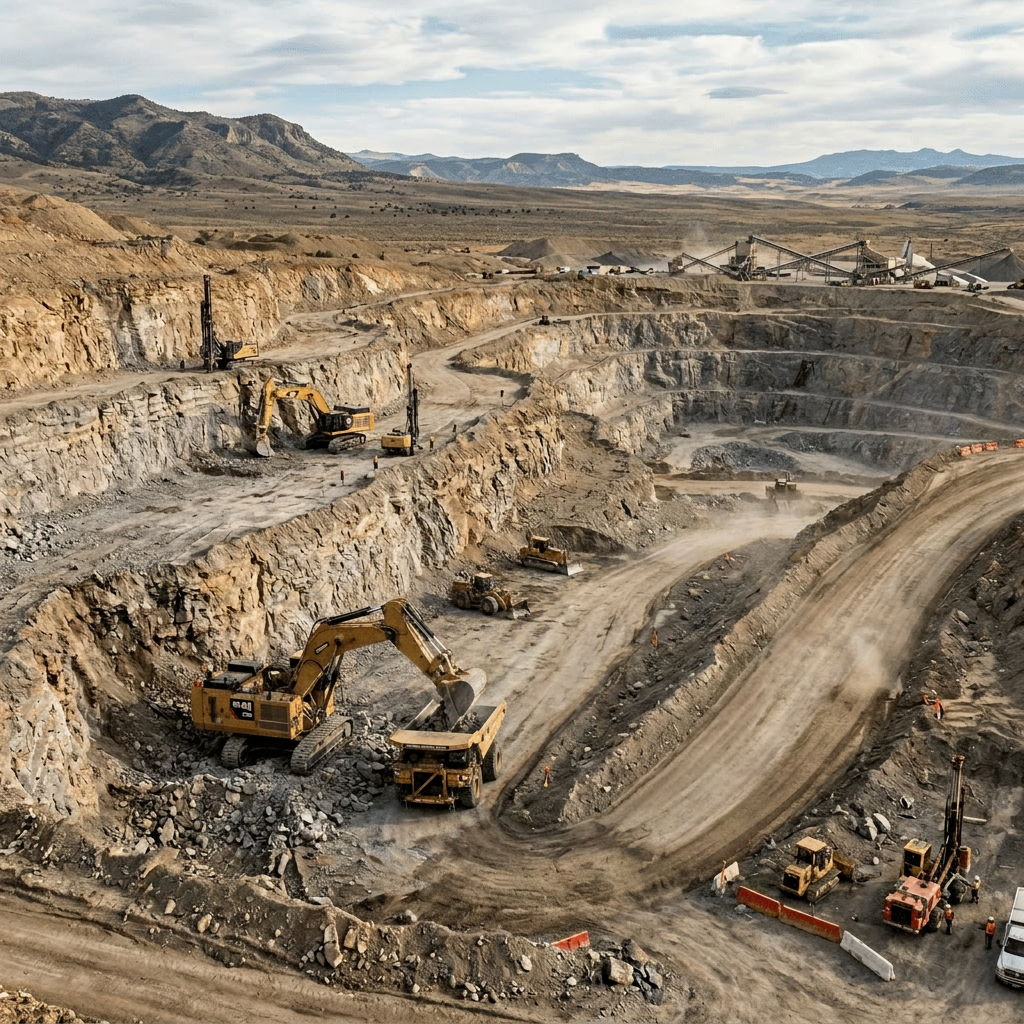
Wyoming leads America’s rare earth revival — Brook Mine, Halleck Creek, and Bear Lodge are reshaping the industry. But REE operations combine mining with chemical processing, a risk class standard carriers won’t touch. This guide covers pollution liability, D&O, builder’s risk, WDEQ bonding, and surplus lines placement for operators and contractors.
Rare Earth Mining Insurance — Wyoming Specialists
Click, Call or Text for a No-Obligation Quote: 818-974-8117 | Steve@cvins.com
Quick Summary: Wyoming has become the center of America’s rare earth revival — the Brook Mine near Sheridan is producing, Halleck Creek ore has been converted into oxide concentrates for a defense-linked buyer, and Bear Lodge continues advancing in Crook County. But rare earth operations combine two risk classes that carriers dislike individually and rarely write together: mining and industrial chemical processing. This guide covers the insurance program a Wyoming REE operation actually needs — from exploration-stage D&O through processing plant property, pollution liability, builder’s risk, and concentrate transit — and why nearly all of it lives in the surplus lines market.
Wyoming’s Rare Earth Moment Is Here — and So Are Its Insurance Problems
For decades, “American rare earth production” meant one place: Mountain Pass, California. That monopoly ended in Wyoming. Three projects now define the state’s REE landscape, each at a different stage — and each with a different insurance profile:
- Brook Mine (Ramaco Resources), Sheridan County. The first new rare earth mining operation in the United States in roughly 70 years, and Wyoming’s first new coal mine in over five decades. Its unconventional coal-and-clay-hosted deposit carries magnet metals — neodymium, praseodymium, dysprosium, terbium — alongside gallium, scandium, and germanium, critical minerals for which Brook may be one of the world’s only primary sources. The company has shifted to a proprietary carbochlorination processing approach and announced plans to roughly triple projected oxide output, plus a strategic stockpile concept for public and private buyers.
- Halleck Creek (American Rare Earths), Laramie Range. One of the largest rare earth projects in the country by tonnage. Ore from Halleck Creek has already been processed into rare earth oxide concentrates for a Pentagon-linked agency — a milestone that signals where offtake demand for Wyoming REEs is heading: defense and national security buyers with their own contractual insurance requirements.
- Bear Lodge (Rare Element Resources), Crook County. One of the most studied REE deposits in North America, advancing through demonstration-scale processing work near the Black Hills.
Wyoming’s deposits carry a genuine advantage worth naming: comparatively low radioactivity relative to many hard-rock REE sources worldwide. That matters for permitting, for community acceptance — and, as we’ll cover below, for underwriting. But even with that advantage, every operator, developer, and contractor in this sector runs into the same wall: rare earth operations are a risk class that standard insurance markets have essentially no experience rating.
Why Rare Earth Operations Are Harder to Insure Than Conventional Mines
A conventional Wyoming surface mine is a known quantity to specialty underwriters: excavation, haulage, crushing, loadout. Rare earth operations bolt an industrial chemical plant onto the back of that mine — and that changes everything.
Separating rare earth elements from ore is chemistry, not just crushing. Whether an operation uses conventional hydrometallurgical solvent extraction or a newer approach like carbochlorination, the processing step involves reagent handling, elevated temperatures, process water circuits, and waste streams. From an underwriter’s chair, that raises problems a coal mine never presents:
- No loss history exists for the technology. Actuaries price risk from historical data. A proprietary first-of-its-kind flowsheet has none. Standard carriers respond to that uncertainty by declining; surplus lines carriers respond by underwriting the specific engineering — reading the process design, the safety systems, the containment — and pricing it individually.
- The pollution exposure is chemical, not just mineral. Conventional mining pollution coverage contemplates sediment, acid rock drainage, and dust. REE processing adds reagent releases, process water excursions, and chemical storage — exposures that belong in a site pollution policy written with the processing operation explicitly described and covered.
- Property values concentrate in one building. A rare earth processing facility can represent hundreds of millions of dollars of specialized equipment. Property coverage, equipment breakdown, and business interruption limits must be built around the plant — because if separation stops, revenue stops, even while the mine keeps digging.
- Radioactivity exclusions lurk in every standard form. Wyoming’s low-radioactivity deposits are an advantage, but “low” is not “zero,” and nearly every GL, property, and pollution form on the market contains broad nuclear and radioactive contamination exclusions. Any naturally occurring radioactive material (NORM) in the ore or waste stream must be disclosed and the program deliberately structured so those exclusions don’t silently void the coverage you think you bought.
The Rare Earth Insurance Program, Stage by Stage
Exploration & Development Stage: D&O Is Not Optional
Most Wyoming REE companies are not yet miners — they are exploration and development companies raising capital on resource estimates, feasibility studies, and development timelines. That business model creates one dominant exposure: securities and shareholder liability. When a stock price moves on drilling results or a timeline slips, shareholder litigation follows — and the rare earth sector has already produced live examples of exactly that. Directors & Officers liability is the coverage that stands between a lawsuit and the personal assets of the people running the company. Alongside D&O, exploration-stage companies need site liability for drill programs, coverage coordination with their drilling contractors, and professional liability where geological reporting and technical disclosures are involved.
Construction Stage: Builder’s Risk for the Processing Plant
Building a separation facility is a nine-figure construction project in a remote location. That demands a builder’s risk program sized to the completed value, covering materials in transit and storage, testing and commissioning (the highest-risk phase of any process plant — hot testing is when things break), and delay-in-startup where lenders or offtake commitments require it. The general contractor and every trade on site — steel erectors, millwrights, electrical, piping, crane crews — need their own placements that don’t exclude industrial plant or mine site work.
Operating Stage: The Full Program
- General Liability — negotiated without mining, chemical operations, or subsurface exclusions; with the additional insured, waiver of subrogation, and primary/non-contributory endorsements that offtake partners and site contracts require.
- Site Pollution / Environmental Liability — written to cover both the mining and the processing operations, including gradual releases, cleanup costs, third-party claims, and defense. This is the single most important policy an REE operation buys.
- Property, Equipment Breakdown & Business Interruption — built around the processing facility’s replacement value and the revenue consequence of downtime, plus inland marine for mobile equipment.
- Workers’ Compensation — Wyoming is a monopolistic state; coverage runs through the state fund, and stop gap employers liability must be added through the GL program because the fund doesn’t include it. Processing plant classifications differ from mining classifications — get them right before the audit, not after.
- Commercial Auto — crew and service fleets at contract-required limits, typically $1M CSL minimum.
- Cargo / Transit — separated oxides are high-value, low-volume cargo moving to defense-linked and industrial buyers under offtake agreements that specify transit insurance, limits, and title transfer points. Motor truck cargo or inland marine transit forms scheduled to actual shipment values close this gap.
- Excess Liability — $5M–$10M+ towers are the norm once offtake partners, lenders, and federal counterparties weigh in, and the excess must follow form over the specialized primaries without reintroducing mining, chemical, or pollution exclusions.
WDEQ Permitting and Bonding Still Applies
Rare earth or not, a Wyoming mining operation answers to the Wyoming Department of Environmental Quality’s Land Quality Division — permit, reclamation plan, and financial assurance before disturbance. Coal-hosted REE operations like Brook run under coal mining permits with WDEQ-LQD oversight; hard-rock projects like Halleck Creek and Bear Lodge follow the non-coal track. Either way, reclamation bonding sized to the state’s cost estimate is a condition of operating, and processing facilities can add to the reclamation and closure obligation. We place WDEQ reclamation surety alongside the insurance program — see our full guide to WDEQ mining bonds and financial assurance, and our complete Wyoming mining insurance guide for the broader state picture.
Contractors: The Rare Earth Buildout Needs You — Insured
Every rare earth project in Wyoming is generating contractor demand right now: drilling companies on exploration programs, earthwork and civil contractors on site development, steel and mechanical trades on plant construction, electricians on high-voltage service, welders and millwrights on installation and maintenance, and haulers moving everything in and out of Sheridan, Wheatland, and Sundance country. If your GL application says “rare earth mine site” and your standard carrier flinches — that’s normal, and it’s fixable through surplus lines placement with the endorsements the project owner’s contract demands. Our guide to insurance for mining support contractors in Wyoming covers every trade in detail, and welders should see our welding contractor insurance guide.
Frequently Asked Questions: Rare Earth Mining Insurance in Wyoming
Is rare earth mining insurance different from regular mining insurance?
The extraction side resembles conventional surface mining, but the processing side is fundamentally different — industrial chemistry with novel flowsheets, reagent handling, and process water management that most mining underwriters have never rated. A complete program combines mining coverage with chemical processing coverage, and very few carriers are comfortable writing both.
Do Wyoming rare earth operations face radioactive material insurance issues?
Less than most REE projects worldwide — Wyoming’s deposits are noted for comparatively low radioactivity, which is a real underwriting advantage. But nearly all standard policies carry broad nuclear and radioactive contamination exclusions, so any NORM handling must be disclosed and the program structured around those exclusions rather than hoping they don’t apply.
What insurance do contractors building or servicing a rare earth plant need?
GL without mining or chemical plant exclusions, Wyoming state fund workers’ comp registration with stop gap employers liability, commercial auto, contractors pollution liability, equipment coverage, and usually $5M+ in total limits. The project owner’s contract exhibit dictates the endorsements — send it to us before you sign.
Do exploration companies need insurance before they mine anything?
Yes — and the most important policy at that stage isn’t a mining policy at all. It’s Directors & Officers liability. REE juniors raise capital on resource estimates and timelines, and shareholder litigation in this sector is a demonstrated, current risk. Drill program site liability and contractor coordination round out the exploration-stage program.
How are rare earth concentrates insured in transit?
Through motor truck cargo or inland marine transit coverage scheduled to real shipment values. Separated oxides are high-value, low-volume freight, and offtake agreements routinely specify transit insurance requirements and title transfer points — the coverage should be built to the contract, not bought off the shelf.
Talk to a Broker Who Understands Both the Mine and the Chemistry
Wyoming’s rare earth industry is being built right now — and the operators, developers, and contractors moving fastest are the ones whose insurance doesn’t hold them back. Whether you’re a junior with a drill program in the Laramie Range, a contractor bidding plant construction near Sheridan, or an operator structuring coverage around a first-of-its-kind processing facility, we place the coverage standard markets won’t touch.
Rare Earth Mining Insurance Quotes — Wyoming & Beyond
Call or Text: 818-974-8117
Email: Steve@cvins.com
Crescenta Valley Insurance | WY License 646611 | CA License 0G58010 | Serving hard-to-place mining risks across 13+ states
Part of our Wyoming mining insurance series — start with the Complete Wyoming Mining Insurance Guide, or see our guides for new mining companies and Nevada mining insurance. This guide is for general informational purposes and is not legal, financial, or coverage advice; policy terms and requirements vary by operation. Company and project references are for industry context only and do not imply any client relationship or endorsement.
- Alternative Energy Insurance for Contractors (2026 Guide)
- Structural Steel Contractor Insurance
- California Idle Well Bonding: AB 1167 & AB 2461 for Operators
- Orphan Well Plugging Insurance: Bidding on Funded Contracts
- California Oil Well Plugging Insurance: P&A Contractor Guide


Leave a Reply