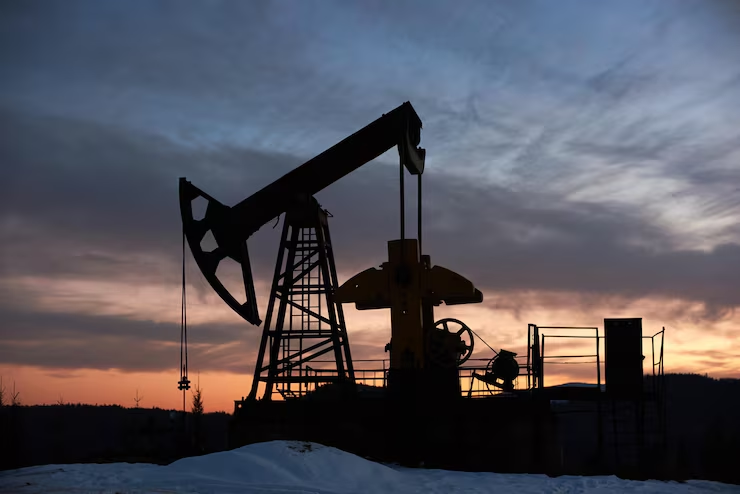
COW Insurance for Small Independent Operators
Small independent oil operators are the most underinsured group in the industry. This guide covers COW coverage, state bonding requirements, and how surplus lines placement actually works.
Control of Well Insurance – Priority Service Available – Call or Text 818-974-8117
Home › Blog › Control of Well Insurance for Small Independent Operators
Control of Well Insurance for Small Independent Operators: What the Big Carriers Won’t Tell You
By Steve McClure, Licensed Surplus Lines Broker — Crescenta Valley Insurance / FCIS Group
CA License 0G58010 | (818) 974-8117 | steve@cvins.com
|
📋 Quick Summary: What You Need to Know • Control of well (COW) insurance covers blowout, cratering, and loss-of-well-control events — none of which your general liability policy will touch. • Small independent operators (1–5 wells) are the most financially exposed group in the industry and the most underinsured. • Every major oil-producing state requires financial assurance (bonding) for well plugging obligations — non-compliance means permit revocation. • The surplus lines market — not your local commercial carrier — is where COW gets placed. Admitted carriers don’t write this risk. • Re-drill coverage, Seepage & Pollution, and Loss of Production Income are the three most chronically underinsured components in small operator programs. • A qualified surplus lines broker can get you an indication in 24–48 hours. Most operators wait until they’re already drilling — that’s too late. |
I’ve been placing control of well insurance for independent operators for years. I work exclusively in the surplus lines market — meaning I handle the risks the standard market has already turned down or won’t bother to quote. Every week I talk to operators who are drilling or producing with the wrong coverage, not enough coverage, or no coverage at all.
This post is not a brochure. It’s what I actually tell operators when they call me, written down in one place. If you run one to five wells in Texas, Oklahoma, New Mexico, Wyoming, North Dakota, or Pennsylvania — and you’re piecing together your insurance program without a specialist — read this before you spud your next well.
1. The Well That Cost Everything: A Real Story
In the spring of 2022, a two-man operation running three shallow gas wells in the Arkoma Basin of eastern Oklahoma had a problem. One of their wells, a Cotton Valley Sand producer they’d held for six years, kicked unexpectedly during a routine workover. The rig crew lost the well. Within four hours it had bridged over and the wellbore was effectively destroyed.
The well had been producing about 85 Mcf/day — not a gusher, but steady income for a two-man shop. The operators had carried a basic general liability policy through a regional agricultural insurer who’d bundled it with their farm coverage. The policy had a $1 million per occurrence limit. It seemed like plenty.
It wasn’t.
The well control specialist bill alone came to $148,000. The re-drill — which was necessary because the production zone was commercially viable and the operators had outstanding royalty obligations — ran $412,000 with a new directional component to avoid the bridged original wellbore. Lost production income during the five-month re-drill period: approximately $130,000 at then-current gas prices.
Total out-of-pocket: approximately $690,000.
Their GL insurer? Denied the claim in its entirety. The adjuster cited the standard CGL pollution exclusion and noted that the policy did not provide well control, re-drill, or loss of production coverage. All of those are specialty coverages that belong in a control of well policy — not a general liability form.
The operators had never been told that. Their local agent didn’t know it either.
They settled the re-drill debt with a working interest lender at punishing terms. One of the two partners eventually exited the industry. The other is still operating — now with proper surplus lines coverage in place.
I tell this story not to scare you but because it is not unusual. It plays out in some variation multiple times a year in every major producing basin. The small independent operator is the most financially exposed participant in the entire oil and gas industry, and the coverage gap is almost always the same: no COW policy, wrong GL form, no re-drill coverage, no seepage and pollution.
|
⚠ Key Takeaways from Section 1 ✔ A standard CGL policy will not cover a blowout or loss of well control. The pollution exclusion is a hard bar. ✔ Well control specialist costs, re-drill costs, and lost production income are three separate coverage parts — none of them are automatically included in a basic COW policy. You have to buy them. ✔ The operators in this story were not negligent. They had insurance. They just had the wrong insurance placed by a generalist who didn’t understand the risk. ✔ The surplus lines market is designed exactly for this risk. A 24-hour placement call could have cost them $15,000–$20,000 annually and covered the entire $690,000 loss. |
2. Who Is a Small Independent Operator?
The term “independent operator” covers an enormous range in the oil and gas industry — from Devon Energy to a guy with two Permian Basin producers and a pickup truck. For insurance purposes, when I say “small independent operator,” I mean:
- Well count: 1–5 producing or drilling wells
- Annual revenue: Under $5 million
- Ownership structure: Individual, LLC, family partnership, or small closely-held corporation
- Operations: Conventional onshore; may include workovers, recompletions, and development drilling
- Staff: Typically 1–10 people; often contractor-heavy
- Experience level: Ranges from 30-year veterans to first-time operators who acquired a producing property
Why the Insurance Market Treats You Differently
The insurance market treats small operators very differently from mid-size or large E&P companies. Large operators have dedicated risk managers, established relationships with London energy markets, and the balance sheet to self-insure a portion of their risk. Small operators have none of that. They’re typically working through a generalist agent, a local commercial carrier, or — worst of all — no coverage at all beyond the state minimum bond.
Where Small Independents Operate
Geography matters too. The bulk of small independent activity sits in five basins: the Permian (West Texas / New Mexico), the Anadarko and Arkoma (Oklahoma), the Haynesville/Cotton Valley corridor (East Texas), the Powder River and Green River (Wyoming), and the Williston (North Dakota/Montana). Each basin has its own regulatory environment, formation pressure profile, and H2S risk — all of which affect coverage availability and pricing.
For a full breakdown of the energy insurance tower that small operators need beyond just COW coverage, see our Oil & Gas Contractor Insurance Requirements: Complete 2025 Compliance Guide.
|
📞 Get Priority Service on Your COW Indication Steve McClure • Licensed Surplus Lines Broker • Active Energy Markets Most small operator programs quote within 24 business hours. Call: (818) 974-8117 | Email: steve@cvins.com CA License 0G58010 — Licensed in TX, OK, WY, NM, ND, NV, AK, PA, NC |
3. What Is Control of Well Insurance — Really?
The insurance industry has its own language and COW coverage is no exception. Here’s what the coverage actually does, without the boilerplate.
A control of well policy is an energy-specific policy form designed to cover the costs associated with a loss of well control event. A “loss of control” in underwriting terms means any situation where the operator can no longer control the flow of fluids or gas from the wellbore through the installed wellhead, BOP stack, or completion equipment. The triggering events are typically defined as:
- Blowout: An uncontrolled release of reservoir fluids, gas, or both to the atmosphere or into a subsurface formation
- Cratering: Subsurface collapse around the wellbore that results in a crater at surface
- Fire: Ignition of wellhead hydrocarbons following a loss of control event
- Well out of control: Any scenario where normal surface control equipment has failed and the well is flowing without operator control
The policy does NOT cover equipment failure in isolation (that’s physical damage coverage), routine production problems, or intentional acts. It also does not cover subsurface blowouts (cross-flow between formations) as a first-party property loss unless specifically endorsed.
The Industry Form: What to Look For
Most COW policies in the U.S. market are written on forms derived from the original Lloyd’s of London energy market language, with U.S.-market modifications. You’ll see references to “OEE” (Operators Extra Expense), “Redrilling and Restoration,” and “Seepage, Pollution & Contamination” as the core coverage parts. Some underwriters bundle them; others price them separately.
The key policy architecture elements to understand:
| Coverage Part | What It Pays | Typical Limit |
| Well Control (OEE) | Specialists, equipment, mob/demob, kill fluid | $1M–$25M |
| Redrilling & Restoration | Cost to re-drill if wellbore is permanently lost | $500K–$10M |
| Seepage, Pollution & Contamination | Third-party BI/PD from pollution escape | $1M–$10M |
| Loss of Production Income (LOPI) | Revenue lost during restoration period | Varies; often 6–12 months production |
| Care, Custody & Control | Damage to third-party property in your care | $250K–$2M |
| Underground Blowout | Cross-flow between subsurface formations | Optional endorsement |
4. The Parts of a COW Policy You Can’t Afford to Skip
This is where small operators consistently get hurt. They buy a COW policy — sometimes at the insistence of a working interest partner or a lender — and they buy the cheapest version available. That almost always means buying just the OEE (well control) section and leaving the rest out. Here’s what each piece does and why it matters.
Redrilling and Restoration Coverage
This is the single most undervalued component in small operator programs. If you lose the wellbore — meaning it bridges, caves, or is otherwise permanently rendered unworkable as a result of a loss of control event — you need to drill a new hole to the same objective formation. For a shallow 5,000–7,000 TVD well in the Arkoma or East Texas, that’s a $400,000–$700,000 exposure. For a Permian Basin well targeting the Wolfcamp or Spraberry at 10,000–12,000 TVD, you’re looking at $1.5 million to $3 million just for the re-drill.
Most small operators don’t buy it because it costs more. Most small operators who’ve had a total wellbore loss event without it wish they had.
Seepage, Pollution and Contamination (SPC)
SPC coverage is the bridge between your COW policy and the third-party bodily injury and property damage exposure that comes with a blowout. When a well blows out, fluids migrate. Produced water contaminates surface water. Gas migrates to neighboring structures. Oil reaches a creek or stock pond. These are third-party claims — they go to the property owner, the rancher, the downstream neighbor.
Your energy GL policy may provide some of this coverage, but it will have a pollution exclusion that limits or eliminates coverage for gradual contamination. SPC on the COW policy is specifically designed for the acute pollution event arising from a blowout. The two coverages complement each other; neither fully substitutes for the other.
For a deeper look at environmental and pollution liability considerations in the oilfield, see our guide on Environmental and Pollution Liability Insurance.
Loss of Production Income (LOPI)
LOPI is business interruption coverage for an oil and gas well. It pays the gross revenue you lose while the well is shut in or undergoing restoration following a covered COW event. For a small operator with two or three wells, the cash flow impact of a single well being down for six months can be existential — lease payments, royalty minimums, debt service, overhead.
LOPI limits are typically set as a multiple of monthly production revenue, with a restoration period (the time the insurer will pay) of 6, 12, or 18 months. Underwriters want to see your current production history — typically six to twelve months of run tickets or revenue statements — to size the limit.
A working interest lender who is relying on production revenue to service a loan will often require LOPI as a condition of financing. If you’re financed, check your loan documents — it may already be required.
|
📝 Submit Your COW Application for Priority Service! Have API numbers, well depths, and formation names ready. We’ll handle the rest. No commitment required — get an indication before you decide. ► Request a Quote at FCISGROUP.COM |
5. State Bonding Requirements: What Every Operator Must Know
Control of well insurance protects you from the financial cost of a blowout. Surety bonds protect the state and the public from the cost of an orphaned, unplugged well. These are two completely different instruments, but small operators frequently confuse them or believe that one satisfies the other. It doesn’t.
Let me be direct: if you hold a drilling permit in any of the states below and you don’t have the required bond in place, you are operating illegally. Permit revocation is the least of your problems — in some states, the regulatory agency can levy civil penalties and prohibit you from future permitting.
For comprehensive information on the surety bond market for oil and gas operators, see our Surety Bond Services page.
★ Texas — Railroad Commission of Texas (RRC)
Texas has one of the most tiered bonding structures in the country, administered by the Railroad Commission of Texas. Bond amounts are determined by the operator’s well count and organization type:
| Bond Type | Amount | Applies To |
| Individual Well Bond | $2,000–$150,000 (depth-based) | Single well operators |
| Blanket Bond — Small Operator | $25,000 | 1–10 wells statewide |
| Blanket Bond — Medium Operator | $50,000 | 11–99 wells statewide |
| Blanket Bond — Large Operator | $250,000 | 100+ wells statewide |
| Alternative: Letter of Credit | Same as applicable bond amount | Irrevocable LOC from RRC-approved institution |
Texas also requires operators to carry a P-5 Organization Report — an annual regulatory filing that certifies the bond is in place and the operator is in compliance. Loss of P-5 status is effectively a permit revocation event. The RRC has been aggressively enforcing financial assurance requirements in recent years following the wave of operator bankruptcies during the 2020 price collapse that left thousands of orphaned wells requiring state-funded plugging.
It’s worth noting that the Texas bond does NOT cover your blowout costs. The RRC bond is purely about well plugging and abandonment. Two completely separate instruments.
★ Oklahoma — Oklahoma Corporation Commission (OCC)
Oklahoma administers oil and gas regulatory bonding through the Oklahoma Corporation Commission Oil & Gas Division. Bond requirements are tiered by well depth and operator activity level:
| Category | Bond Requirement |
| Individual well bond (any depth) | $1,000–$5,000 per well (depth-scaled) |
| Blanket bond — active operator | $25,000 (up to 50 wells) |
| Blanket bond — large operator | $50,000 (50+ wells) |
Oklahoma has a unique concern for small operators in certain areas: induced seismicity. Wastewater disposal wells in parts of the Anadarko Basin have been associated with elevated seismic activity. Oklahoma’s COW underwriters will ask specifically about disposal well operations and proximity to seismically active areas, and some will exclude or sublimit coverage accordingly.
★ New Mexico — Oil Conservation Division (OCD)
New Mexico’s Oil Conservation Division has one of the more aggressive financial assurance programs in the West, reflecting the state’s large population of marginal and inactive wells. Operators are required to post bonds based on total well count and depth:
| Category | Bond Amount |
| Per-well bond (0–4,000 ft TVD) | $2,000 |
| Per-well bond (4,001–10,000 ft TVD) | $5,000 |
| Per-well bond (10,001+ ft TVD) | $10,000 |
| Blanket bond (any depth) | $30,000 |
| LOC alternative | Accepted in lieu of surety bond, same amounts |
The Permian Basin side of New Mexico — particularly Eddy and Lea Counties — is one of the highest-activity small operator environments in the country. Permitting activity in the Delaware Basin has been intense, and the OCD has been actively auditing financial assurance compliance. Small operators who acquired legacy Permian assets from larger companies need to verify that bond assignments were properly executed and accepted by the OCD at closing.
★ Wyoming — Oil and Gas Conservation Commission (WOGCC)
Wyoming’s Wyoming Oil and Gas Conservation Commission has a tiered bond structure based on the number of wells the operator holds in the state:
| Bond Category | Amount Required |
| Individual well bond | $10,000–$30,000 (depth-scaled) |
| Blanket bond (1–10 wells) | $50,000 |
| Blanket bond (11–100 wells) | $100,000 |
| Blanket bond (100+ wells) | $150,000 |
Wyoming also requires a Drilling Permit Bond specifically for new well drilling, separate from the general well plugging bond. Operators drilling in the Powder River Basin, DJ Basin, or Green River Basin need to confirm they have both instruments in place before spud.
For our detailed overview of Wyoming-specific mining and energy insurance requirements — which often overlap with small operator concerns in the Rockies — see our post on Wyoming energy and mining insurance.
★ North Dakota — North Dakota Industrial Commission (NDIC)
North Dakota’s Williston Basin has attracted a significant number of small working interest owners and operators in recent years, many of whom are unfamiliar with the state’s financial assurance requirements. The NDIC Oil and Gas Division administers bond requirements as follows:
| Category | Bond Amount |
| Individual well bond | $50,000 per well |
| Blanket bond (up to 10 wells) | $100,000 |
| Blanket bond (over 10 wells) | $200,000 |
| Plugging bond (inactive wells only) | Calculated per well based on plugging cost estimate |
North Dakota has some of the highest individual well bond requirements in the country, reflecting the depth and complexity of Bakken and Three Forks completions (typically 10,000–13,000 TVD). The NDIC has also been actively reviewing the sufficiency of blanket bonds for operators with large inactive well inventories.
★ Pennsylvania — Department of Environmental Protection (DEP)
Pennsylvania’s bond requirements are administered by the PA Department of Environmental Protection and are structured differently from the western states — Pennsylvania uses both oil/gas well bonds and a separate unconventional well (shale) category:
| Well Type | Bond Requirement |
| Conventional oil/gas well (per well) | $2,500 |
| Conventional blanket bond | $25,000 (up to 25 wells); $50,000 (26–100 wells) |
| Unconventional (Marcellus/Utica) per well | $4,000–$10,000 (depth-based) |
| Unconventional blanket bond | $600,000 (1–25 wells); up to $2M for 100+ wells |
Pennsylvania is notable for having significantly higher blanket bond requirements for unconventional (shale) operators compared to the western states. Marcellus and Utica operators should carefully review whether their blanket bond level is still in compliance as they add new locations. Act 13 of 2012 established the current framework, and the DEP has authority to increase bond amounts based on operator-specific risk assessments.
|
📎 Need a Surety Bond for Your Oil & Gas Operations? CVI places oil & gas operator bonds in TX, OK, NM, WY, ND, PA and more. Most small operator bonds bind within 1–2 business days. Call: (818) 974-8117 | Submit Online |
6. How Underwriters Look at Small Independent Operators
I want to pull back the curtain on the underwriting process because most small operators have never seen it. When I submit your account to an energy underwriter, here is exactly what they are looking at — and what’s going to get your application declined or priced punitively.
Operator Experience is the Single Biggest Factor
COW underwriters are experience actuaries at heart. They want to know how many wells you’ve drilled, how many years you’ve been an operator of record, and whether you have a documented well control incident history. A first-time operator — even one who is technically competent and has 20 years as a company man — will pay a higher rate per $1,000 of coverage than a 15-year veteran operator with a clean loss history.
This is not negotiable. It’s priced into the actuarial model. What you can do is provide as much documentation of relevant experience as possible: prior operator of record status on other wells (even in a different entity), years in the industry in non-operator roles, IADC well control certifications for yourself and your contracted rig crews, and documented well control procedures.
Formation and Depth Drive the Exposure
Underwriters price COW coverage based on the probability and cost of a loss of control event. Those two variables are primarily driven by:
- True Vertical Depth (TVD): Deeper wells generally mean higher formation pressure and more complex well control scenarios. A 15,000 TVD Haynesville well is a fundamentally different risk than a 5,000 TVD Cotton Valley well.
- Formation pressure: Abnormally pressured reservoirs (anything above the normal gradient of ~0.465 psi/ft) require closer scrutiny. If you’re drilling into known overpressured formations, disclose it upfront.
- H2S content: Hydrogen sulfide (sour gas) is the most significant hazard multiplier in COW underwriting. Sour gas operations require specialized equipment, HAZWOPER-trained crews, and emergency response planning. The premium impact is significant — sometimes 2x–3x the equivalent sweet gas rate.
- Well type: Development wells in a known productive interval are priced more favorably than wildcat exploratory wells in untested formations.
The Submission Package That Gets You a Real Quote
I’ve seen operators call me the day before they spud expecting a bound policy by morning. That’s not realistic. Here’s what a proper COW submission requires, and why each piece matters:
| Submission Item | Why the Underwriter Needs It |
| API well numbers | Identifies specific wells; underwriter pulls regulatory history |
| Well location (county, state, basin) | Geographic hazard assessment; basin-specific H2S prevalence |
| Target formation and TVD/TMD | Depth and formation pressure exposure |
| Anticipated wellhead pressure (psi) | BOP specification adequacy; kick intensity potential |
| H2S content (ppm or %) | Sour gas hazard classification; emergency response requirements |
| Operator experience statement | Loss history; years as operator; well count |
| Type of operation (drilling, workover, producing) | Determines applicable coverage trigger and rate |
| Requested limits for each coverage part | Underwriter can’t price without knowing what you need |
| Current production volumes (LOPI applications) | Required to underwrite LOPI limit and period |
| Existing insurance program | Coordination of coverage; avoidance of gaps or duplication |
7. The Coverage Gaps That Kill Small Operators
Based on the placements I handle and the claims I hear about after the fact, here are the most common coverage gaps that cause catastrophic financial losses for small independent operators. I’m not being alarmist — I’ve seen each of these play out.
Gap #1: The Wrong GL Form
Most small operators who have “insurance” have a commercial general liability policy. What they often don’t realize is that there are two fundamentally different GL forms in the oilfield: the standard ISO CGL form (CG 00 01) and the energy/oilfield GL form. The ISO CGL has a total pollution exclusion that effectively bars coverage for the majority of oilfield claims — including blowout-related third-party claims, produced water releases, and spill response costs.
An energy GL policy written on an oilfield form with a “sudden and accidental” pollution buy-back provides materially better coverage for the actual risks you face. The premium difference is real but typically not dramatic for small operators. The coverage difference can be the difference between a paid claim and a bankruptcy.
Gap #2: Inadequate OEE Limits
I regularly see small operators with $250,000 or $500,000 OEE limits who are drilling wells where the well control specialist mobilization alone could run $200,000–$300,000. Wild Well Control, Boots & Coots, Alert Disaster Control — these firms charge market rates and they are not cheap.
A realistic minimum for any well with pressures above 2,000 psi or depth above 8,000 TVD is $1 million OEE. For Permian Basin Wolfcamp or Haynesville Shale wells, you need to be at $3–$5 million. Don’t buy based on what the premium quote looks like at a low limit — buy based on what a realistic worst-case well control event actually costs.
Gap #3: No Workover Coverage
A producing well COW policy often covers the well in its current producing state. It may not automatically cover workover operations — the period when you have a rig over the well, the wellhead is off, and the well control exposure is actually at its highest. Workover coverage may require a specific endorsement, a separate workover COW policy, or a notification to the insurer prior to beginning operations.
The Arkoma Basin operators in the story at the beginning of this post lost their well during a workover. Their producing well policy did not extend to workover operations. That’s a gap that exists in far more small operator programs than the industry wants to admit.
Gap #4: Improper Named Insured Structure
Many small operators run their wells through multiple entities — an operating company, a holding company, individual working interest owners. If the policy is issued to the operating entity and a loss occurs at a well held in a different entity, coverage may be disputed. Get your entity structure right before you buy the policy. Every named insured should be listed; working interest partners with operational responsibility should be added by endorsement.
Gap #5: Lapsed or Wrong-Dated Bond
Surety bonds have effective and expiration dates. A bond that expires mid-year without renewal puts your permits in default — even if you’ve had it in place for years. Most state agencies have 30-day cure periods, but some don’t, and a default triggers a notice that becomes part of your regulatory record. Set calendar reminders. Your broker should notify you 60 days before any bond expiration.
8. Getting Placed: What a Surplus Lines Broker Actually Does
I want to demystify the surplus lines placement process because a lot of small operators don’t know what to expect from it, and as a result they either don’t seek it out or they end up working with a generalist broker who’s never placed an energy account in their career.
Why the Admitted Market Won’t Help You
The admitted market — State Farm, Travelers, Hartford, your local regional carrier — will not write COW coverage. Full stop. COW is a surplus lines risk. That means it’s placed through a licensed surplus lines broker (like me) directly with non-admitted specialty insurers: Lloyd’s of London syndicates, U.S. non-admitted energy carriers, and program underwriters who specialize in oil and gas.
The Markets I Work With
The key markets I work with for small operator COW programs include AmWINS Houston (which accesses multiple Lloyd’s syndicates), Appalachian Underwriters, Burns & Wilcox Energy, and several program underwriters specifically designed for the 1–5 well operator segment. Each has different appetites for operator experience, geography, well depth, and H2S exposure.
What Happens When You Call Me
When a new operator calls my line, here’s the typical flow:
- Initial intake call (15–30 minutes): I get the basic well information, operator background, and what you need. I also look for any red flags that might affect marketability — H2S above 500 ppm, very new operators, prior losses, unusual formations.
- Submission preparation: I prepare a complete submission package and send it to 2–3 markets simultaneously. This is where having actual energy market relationships matters — I’m not cold-calling an underwriter, I’m sending a submission to someone I talk to regularly.
- Indications received (24–48 hours): For straightforward small operator programs, I typically have an indication within one to two business days. Complex programs (deep wells, sour gas, new operators) may take longer.
- Coverage comparison and recommendation: I present the options with an explanation of what each covers and doesn’t cover. I don’t just send you the cheapest quote — I tell you what you’re getting for the premium.
- Bind and issue: Once you select a program, I bind coverage and issue certificates. For state filing purposes, I also handle the surplus lines tax filing in your state (required in all states for non-admitted placements).
The biggest mistake small operators make is waiting until they’re in the middle of drilling to call. Underwriters will not bind coverage on a well that’s already drilling without detailed well control procedures and potentially a higher premium. Call before the rig moves in.
For our broader look at the oil and gas insurance program — including the full coverage tower beyond COW — see our Permian Basin Operator Insurance Guide.
|
🔎 Don’t Wait Until You’re On Location Most COW claims happen in the first well — when the operator is newest and least insured. Get covered before you spud, not after the kick. Call Steve: (818) 974-8117 Or submit a quote request online › |
9. Pre-Drilling Insurance and Bonding Checklist
Use this checklist before you spud any new well. It covers the insurance and bonding minimums for a responsible small operator. Every item on this list has a coverage gap behind it that I’ve seen cost someone real money.
The Complete Pre-Spud Checklist
| Notes | ||
| ☐ | State operator bond in place and current | Check expiration date; confirm RRC / OCC / OCD / WOGCC / NDIC / DEP has current document on file |
| ☐ | COW policy bound — OEE component | Minimum $1M for any well >4,000 TVD or >500 psi WHP |
| ☐ | Re-drill coverage included | Limit should reflect actual AFE to drill replacement well to same formation |
| ☐ | SPC coverage included | Minimum $1M; more for populated areas or proximity to water bodies |
| ☐ | Workover operations covered under COW policy | Verify with broker; may require notification or separate endorsement |
| ☐ | Energy GL on oilfield form (not standard ISO CGL) | Must include sudden & accidental pollution; confirm blowout is not excluded |
| ☐ | Named insured structure reviewed | All operating entities listed; WI partners added if operationally responsible |
| ☐ | Rig contractor’s insurance verified | Get COI from drilling contractor; confirm limits meet JOA/contract requirements |
| ☐ | Workers’ compensation in place | Must cover all direct employees; verify contractor WC as well |
| ☐ | LOPI coverage in place if financed | Check loan agreement for insurance requirements; LOPI may be required by lender |
| ☐ | H2S emergency response plan documented | Required by OSHA; also affects COW underwriting; affects sour gas rate |
| ☐ | IADC Well Control certification for rig crew | Not universally required but improves underwriting position; some markets require it |
10. Frequently Asked Questions
Q: What is control of well insurance?
Control of well (COW) insurance covers the cost of regaining control of a well that has experienced a blowout, crater, or loss of control. It pays for well control specialists, equipment, mob/demob, kill fluid, and related services — expenses that can exceed $1 million even on a shallow well. It is a specialty form that has no equivalent in the standard commercial insurance market.
Q: Do small independent operators really need control of well insurance?
Yes — arguably more than large operators. A major E&P company can absorb a $500,000 well control event on its balance sheet. A two-well independent cannot. For small operators, a single blowout without COW coverage can mean bankruptcy. The premium for a basic small operator COW program is typically $10,000–$25,000 annually — a fraction of the exposure.
Q: What is the minimum premium for control of well coverage?
In the surplus lines market, minimum premiums for small operator COW programs typically start around $10,000–$15,000 annually for shallow, sweet gas wells with experienced operators. Complex programs (deep wells, high-pressure, sour gas, multiple wells) can run $50,000–$150,000+. New operators and first wells typically carry a loading above the minimum.
Q: What states require operators to carry well control coverage?
Most states require financial assurance (bonding) rather than mandating a COW insurance policy specifically. Texas (RRC), New Mexico (OCD), Oklahoma (OCC), Wyoming (WOGCC), North Dakota (NDIC), and Pennsylvania (DEP) all have bonding requirements. Some working interest agreements (JOAs) and lender requirements may mandate COW insurance above and beyond the state bond. See Section 5 of this post for a state-by-state breakdown.
Q: What is the difference between a blanket bond and a well-specific bond?
A blanket bond covers all wells an operator has permitted in a state under a single instrument. A well-specific (individual) bond covers one well. Most states allow operators to choose between the two, but blanket bonds are typically more cost-effective once you hold more than two or three permits. The regulatory agency must confirm acceptance of the blanket bond form — not all agency districts process them identically.
Q: Can I use a letter of credit instead of a surety bond?
In most oil and gas producing states, yes. Texas Railroad Commission, New Mexico OCD, and Wyoming WOGCC all accept irrevocable letters of credit as an alternative to surety bonds. The LOC must be issued by an approved financial institution and meet specific formatting requirements set by the regulatory agency. LOCs tie up capital at your bank — surety bonds typically do not, making bonds the more capital-efficient choice for most small operators.
Q: What does re-drill coverage pay for?
Re-drill coverage, sometimes called “extra expense — re-drilling and restoration,” pays the cost to drill a new wellbore to the same formation if the original hole is permanently lost as a result of a covered loss of control event. It is one of the most valuable — and most often underinsured — components of a COW policy. The limit should reflect your actual anticipated re-drill cost, not an arbitrary round number.
Q: What is Seepage, Pollution and Contamination (SPC) coverage and why do I need it?
SPC coverage pays for third-party bodily injury and property damage caused by the escape of oil, gas, produced water, or other well fluids — including migration into groundwater, soil contamination, and third-party crop or property damage. Standard general liability policies exclude pollution. SPC fills that gap specifically for oilfield pollution events arising from a loss of well control. Without it, a neighboring landowner’s contamination claim against you has no coverage vehicle.
Q: Will my general liability policy cover a blowout?
Almost certainly not. Standard commercial general liability (CGL) policies contain a pollution exclusion that bars coverage for most blowout-related third-party claims. Energy-specific GL policies underwritten on ISO oil and gas forms may provide some coverage with a sudden and accidental buy-back, but the bodily injury and property damage limits on a GL policy are typically insufficient for a major well control event. COW and SPC coverage are the correct instruments for blowout-related loss.
Q: How do I get a control of well quote as a new or startup operator?
The standard admitted market won’t touch new operators — COW is a surplus lines placement. You need a licensed surplus lines broker with active energy markets. Key submission information: well locations (API numbers), target formation and depth, TVD/TMD, anticipated pressure (psi), H2S content, operator experience (years, well count), current and proposed operations, and any existing well control procedures or IADC-certified personnel. A qualified broker can typically get an indication within 24–48 hours from first submission.
11. Conclusion: The Broker’s Bottom Line
I’ve placed COW programs for operators running one well on a shoestring and operators running a dozen-well development program in the Permian Basin. The conversations are remarkably similar. Almost everyone comes in underinsured. Almost everyone has a GL policy from a generalist carrier that won’t touch a blowout claim. And almost everyone has never had a broker sit down and walk through the actual coverage architecture.
The Coverage You Actually Need
The small independent operator occupies a strange position in the oil and gas industry. You’re carrying the full operational liability of a major E&P company — wells, pressure, H2S, produced fluids, surface impacts — but without the risk management department, the dedicated insurance budget, or the London market relationships. The majors have people whose entire job is making sure coverage doesn’t gap. You’ve got a phone and whoever picks it up.
That’s what a specialty surplus lines broker is supposed to be for you. Not someone who sells you a GL policy that doesn’t work and moves on. Someone who knows the COW market, knows what terms look like for your specific well profile, and picks up the phone when something goes sideways.
Don’t Let Your Bond Lapse
The bonding side is non-negotiable. Every state in this post has teeth — the Texas RRC in particular has been pulling permits from operators who’ve gone dark on their P-5 and bond renewals. Get bonded, stay bonded, and put the renewal on your calendar like a tax deadline.
On the insurance side, the minimum viable program for a small operator with wells in production or drilling mode is: a properly-structured COW policy with OEE, re-drill, and SPC; an energy GL on an oilfield form; workers’ compensation; and commercial auto. If you’re financed, add LOPI. If you’re drilling, call before you spud.
For authoritative well control and blowout prevention information, the International Association of Drilling Contractors (IADC) Well Control program is the industry standard. For regulatory compliance resources specific to each state, the Interstate Oil and Gas Compact Commission (IOGCC) maintains a comprehensive state-by-state directory. For EPA environmental requirements relevant to oilfield spill response, see the EPA’s Oil Spills Prevention and Preparedness Regulations.
If you’re a small independent operator with wells in TX, OK, NM, WY, ND, or PA — or any state in between — and you’re not sure your current insurance program covers what you think it does, call me. The conversation is free. The alternative is learning about your coverage gap from an adjuster.
|
⚡ Ready to Get Properly Covered? Steve McClure • Licensed Surplus Lines Broker Crescenta Valley Insurance / FCIS Group • fcisgroup.com ✅ Active COW markets for 1–10 well operators ✅ Surety bonds for TX, OK, NM, WY, ND, PA ✅ Energy GL, Workers’ Comp, Commercial Auto ✅ Priority service on most small operator programs 📞 (818) 974-8117 steve@cvins.com | Submit a Quote Request CA License 0G58010 — NPN 13684036 — Licensed in CA, TX, OK, AK, WY, NV, NM, ND, NC, PA |
This article is intended for informational purposes only and does not constitute legal, regulatory, or insurance advice. Coverage availability, terms, and premiums vary by individual risk, state, and market conditions. Bond requirements described herein reflect general guidance as of the date of publication and may be subject to change by the applicable regulatory authority. Operators should consult with a licensed surplus lines broker for coverage specific to their operations and with legal counsel for regulatory compliance questions. Crescenta Valley Insurance operates as part of the FCIS Group at fcisgroup.com.
- Directional Drilling Contractor Insurance: HDD & Fiber Guide
- Pennsylvania Welding Contractor Insurance for Foundry, Mill & Structural Work.
- How to get Agriculture Environmental Insurance?
- Asbestos Abatement Contractor Insurance: California C-22 Guide
- Battery Storage (BESS) Insurance


Leave a Reply