
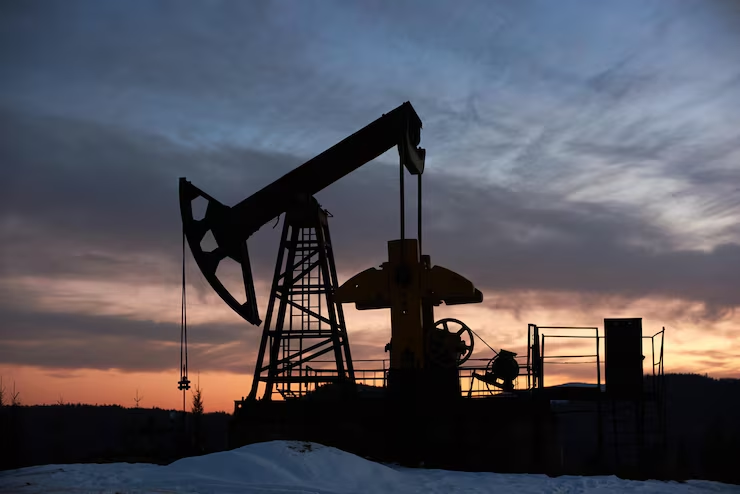
New Mexico Fracking Insurance and Surety Bonds. E-mail, Call, Text, or Fill out our quick contact form.
818-974-8117 | Steve@cvins.com |
Navigating New Mexico Fracking Insurance: A New Company’s Guide to Bonding Requirements in the Permian Basin
🚨 The Call That Changed Everything
It was 3:47 AM when Jake Martinez’s phone rang in his cramped Austin hotel room. The voice on the other end belonged to his drilling supervisor, calling from a freshly completed pad site just across the Texas-New Mexico border in Lea County. “Boss, we’ve got a problem,” came the urgent whisper. “The state inspector is here, and they’re asking about our New Mexico plugging bonds. They won’t let us spud tomorrow without them.”
Jake’s heart sank as he realized the gravity of the situation. His small independent oil company had spent eighteen months securing mineral leases, raising capital, and assembling a drilling program in the prolific Permian Basin. They’d done their homework on the Texas side of operations, but somehow, the intricate web of New Mexico Fracking Insurance and bonding requirements had slipped through the cracks. What should have been a routine cross-border drilling operation was now threatening to derail his entire company’s future.
This scenario plays out more often than industry veterans care to admit. The Permian Basin, straddling the Texas-New Mexico border, represents one of America’s most productive oil and gas regions. However, the regulatory landscape between these two states differs dramatically, and New Mexico’s stringent bonding and insurance requirements catch many newcomers off guard.
🏛️ Understanding New Mexico’s Regulatory Environment
New Mexico’s approach to oil and gas regulation reflects the state’s commitment to environmental protection while balancing economic development. The New Mexico Energy, Minerals, and Natural Resources Department’s Oil Conservation Division (OCD) oversees all drilling, completion, and abandonment activities within the state’s boundaries. For companies venturing into the Land of Enchantment’s portion of the Permian Basin, understanding these requirements isn’t just advisable—it’s absolutely essential for operational success.
The Division reviews forms and reports, compiles and tracks well data; production of wells and well location mapping; conducts the permitting, plugging and restoration of well sites; investigates and inspects wells; ensures well operations meet the states regulatory standards; and provides a process in the event an operator fails to perform the duties to meet the financial assurance requirement.
📈 The Evolution of New Mexico Bonding Requirements
Recent years have witnessed significant changes in New Mexico’s bonding requirements, driven by environmental concerns and the state’s determination to avoid being left with orphaned wells when operators fail financially. The new rules increase the amount operators in the state must provide as a guarantee to the New Mexico Oil Conservation Division from $50,000 to $250,000. This substantial increase reflects growing awareness of the true costs associated with well plugging and site remediation.
Sobering Statistics: According to Fuge, there are already about 2,000 abandoned wells in New Mexico, with an estimated plugging and remediation cost approaching $500 million, and the state has just $162 million set aside for those expenses.
💰 Specific Bonding Requirements for New Mexico Fracking Insurance
New Mexico operates on a tiered bonding system that accommodates both single-well operations and larger blanket programs. Understanding these requirements is crucial for any company planning to establish operations in the state’s Permian Basin counties of Eddy and Lea.
🔧 Single Well Bonds
Current Requirement: A $25,000 plus $2 per ft of well depth surety bond is required for either horizontal or vertical wells. (Effective 1/14/19)
Example Calculations:
- 10,000-foot horizontal well: $45,000 ($25,000 base + $20,000 for depth)
- 15,000-foot well: $55,000 ($25,000 base + $30,000 for depth)
📋 Blanket Bonds
For operators planning multiple wells, New Mexico offers blanket bonding options. A surety bond is required for multiple wells, from $50,000 to $250,000. The specific amount depends on the number of wells planned and their respective depths.
⏰ Bond Duration and Requirements
CRITICAL: A surety bond must be in place from the time of the initial permit up to plugging of the well and does not have the option to be canceled. The premium will renew on the bond on an annual basis for the life of the well.
🏛️ New Mexico State Land Office Requirements
For operations on state land, additional bonding requirements apply through the New Mexico State Land Office (NMSLO):
Single lease Surface Damage Bond
Provides surety for one oil and gas lease
Megabond
Provides surety for multiple oil and gas leases
🛡️ Insurance Requirements Beyond Bonding
While bonding addresses the state’s financial assurance needs for well plugging and remediation, New Mexico Fracking Insurance encompasses a broader spectrum of coverage requirements.
⚖️ General Liability Insurance
General liability insurance forms the foundation of any comprehensive New Mexico Fracking Insurance program. This coverage protects against third-party bodily injury and property damage claims arising from operations.
👷 Workers’ Compensation
Important: All licensed contractors with employees are required to hold a workers’ compensation policy. Entities like a corporation or LLC are required to carry workers’ compensation insurance even if they have zero employees.
🌍 Environmental Liability
Environmental liability insurance protects against cleanup costs, third-party claims, and regulatory fines related to pollution incidents.
💥 Well Control Insurance
Also known as “blowout insurance,” well control coverage addresses one of the most catastrophic risks in oil and gas operations.
🌎 The Permian Basin’s Unique Challenges
The Permian Basin’s position straddling the Texas-New Mexico border creates unique regulatory challenges for operators. New Mexico’s Oil Conservation Division (OCD) and the Texas Railroad Commission (RRC) signed an agreement to regulate interstate oil and gas facilities in tandem.
🔄 Cross-Border Operations
For companies drilling horizontal wells that cross state lines, dual compliance becomes necessary. A well spudded in Texas but terminating in New Mexico must satisfy both states’ bonding requirements.
📊 Production Growth and Infrastructure
Growth Stats: New Mexico has become a U.S. leader in energy production over the past five years, with oil production exceeding 2 million barrels per day in 2024, making it the nation’s second-largest oil producer.
📋 Recent Legislative Developments
HB133 Proposal: Would increase bond requirements to reflect the ever-increasing cost of plugging abandoned wells — currently around $125,000 for plugging. Land remediation costs can run into the millions.
💵 Financial Planning Considerations
The substantial bonding requirements and comprehensive insurance needs associated with New Mexico Fracking Insurance represent significant upfront costs for new operators.
Typical Delaware Basin Program Costs:
- $100,000-$200,000 in plugging bonds
- $50,000-$100,000 in surface damage bonds for state land operations
- $500,000-$2,000,000 in annual insurance premiums
💡 Alternative Financial Assurance Options
New Mexico regulations provide flexibility in meeting bonding requirements:
💰 Cash Deposits
Equal to required bond amount
📄 Letters of Credit
Bank-issued guarantees
🔒 Surety Bonds
Traditional bonding approach
✅ Best Practices for New Mexico Market Entry
🏛️ Early Regulatory Engagement
Begin conversations with the Oil Conservation Division and State Land Office early in the planning process.
🤝 Professional Partnerships
Work with agents and brokers who specialize in oil and gas operations.
📊 Risk Assessment
Conduct thorough environmental and operational risk assessments.
💰 Financial Reserves
Maintain adequate reserves for unexpected requirements.
🚀 Technology and Efficiency Improvements
Productivity Gains: Labor productivity in the extraction portion of the upstream oil and gas industry increased 174 percent from 2010 through 2023, compared with an 18 percent improvement in the nonfarm business sector.
💧 Water Management and Environmental Considerations
Water Efficiency: Improvements over the past ten years have reduced the use of fresh water in fracture treatments from roughly 100% in the early 2010s to under 3% in 2022.
🛣️ The Path Forward
As Jake Martinez learned during that early morning crisis call, success in New Mexico’s Permian Basin requires more than just geological expertise and drilling capital. The state’s comprehensive regulatory framework demands careful attention to bonding and insurance requirements from day one of operations.
The investment in proper New Mexico Fracking Insurance and bonding represents more than regulatory compliance—it demonstrates the commitment to responsible operations that New Mexico regulators and communities expect.
For new operators entering this dynamic market, the complexity of requirements shouldn’t serve as a deterrent but rather as motivation to engage experienced professionals and plan comprehensively. The Permian Basin’s enormous potential rewards make the investment in proper financial assurance worthwhile for well-prepared companies.
🌶️ New Mexico Fun Facts: Discovering the Land of Enchantment 🌵
As we conclude our exploration of New Mexico Fracking Insurance requirements, let’s take a moment to appreciate some fascinating facts about the state that’s become America’s second-largest oil producer:
🏛️ Historic Distinction
The Palace of the Governors in Santa Fe is the oldest government building in the Nation. The Spanish built it as part of a fortress during the winter of 1609-1610. This historic structure has witnessed over 400 years of governance, from Spanish colonial rule through territorial status to modern statehood—quite a perspective on regulatory evolution!
⛰️ Sky-High Capital
Santa Fe is the highest capital city in the United States, at 7,000 feet above sea level. This elevation provides stunning vistas but also creates unique logistical challenges for oil and gas operations moving equipment to and from the state capital for regulatory meetings.
🎯 Additional Captivating New Mexico Facts:
💣 Nuclear History
The world’s first Atomic Bomb was detonated on July 16, 1945, on the White Sands Testing Range near Alamogordo. The Trinity Site remains a landmark of scientific achievement.
👁️ Five-State Vista
Standing on the 8,182-foot Capulin Volcano, you can see five states: New Mexico, Oklahoma, Texas, Colorado, and Kansas!
🌶️ Spice Capital
Hatch, New Mexico, is the “Green Chile capital of the world.” The state’s famous green chile provides a spicy counterpoint to energy operations.
🛣️ Unpaved Roads
Since New Mexico’s climate is so dry, 3/4 of the roads are left unpaved. The roads don’t wash away, affecting equipment transportation logistics.
🎈 Balloon Festival
Albuquerque hosts the world’s largest hot air balloon festival, creating temporary airspace restrictions that oil and gas helicopter operations must navigate.
🏜️ Native Heritage
The Navajo are the largest Native American Group in the U.S., with 78,000 members in New Mexico and a reservation covering 14 million acres.
🗣️ Cultural Diversity
One out of three families in New Mexico speak Spanish at home, influencing communication strategies for safety training and community relations in oil and gas operations.
New Mexico’s unique blend of ancient cultures, dramatic landscapes, and modern energy production creates a regulatory environment unlike anywhere else in America. Understanding both the technical requirements and cultural context helps operators build successful, sustainable operations in this remarkable state.
Whether you’re planning your first New Mexico drilling program or expanding existing operations, remember that success requires more than just understanding the geology—it demands respect for the regulatory framework, the environment, and the communities that call the Land of Enchantment home. With proper planning, professional guidance, and comprehensive New Mexico Fracking Insurance, your company can join the ranks of successful operators contributing to America’s energy independence while honoring the state’s rich heritage and environmental stewardship goals.
📞 For more information about New Mexico Fracking Insurance and bonding requirements, contact CVI’s experienced energy insurance specialists who can help navigate the complexities of operating in the Land of Enchantment. 🏜️ Steve McClure is available at 818-974-8117 or Steve@CVINS.com


Leave a Reply